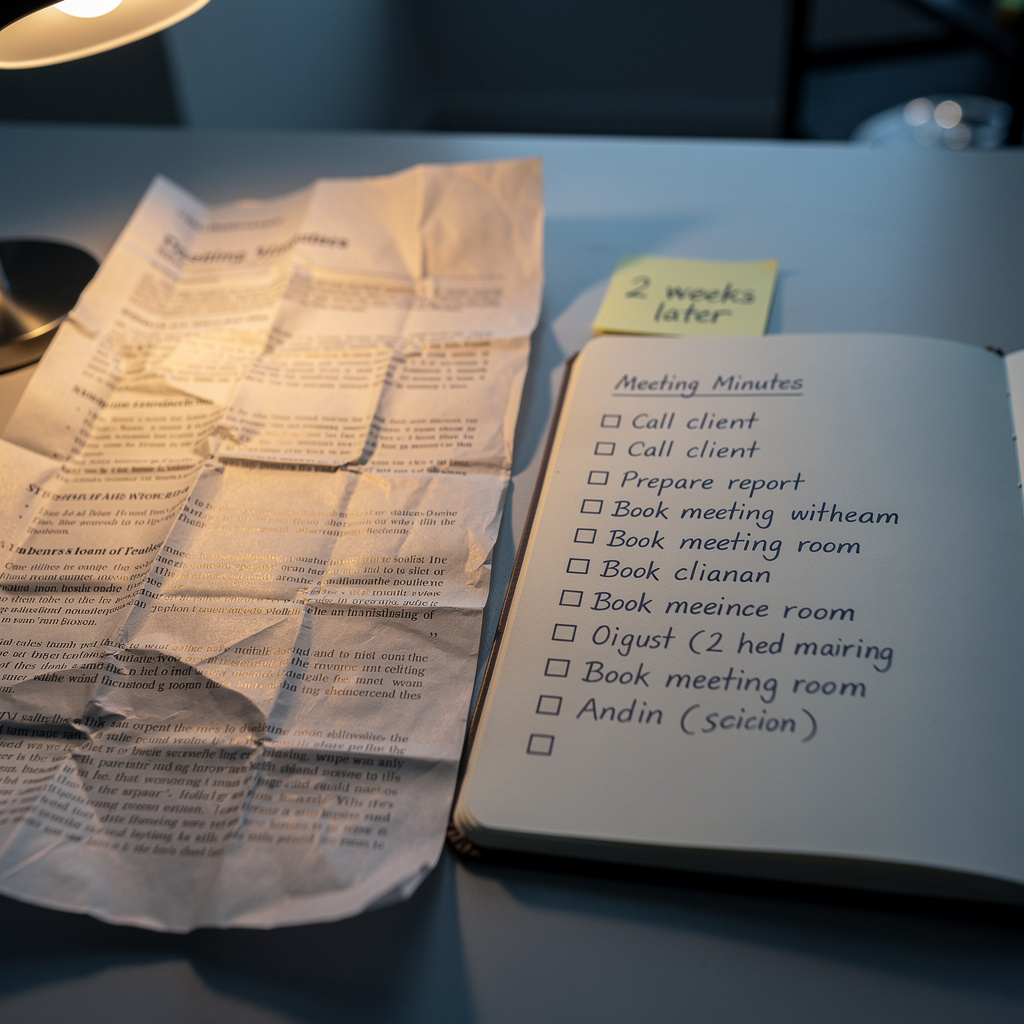
The meeting went well. The minutes were sent out. And yet, two weeks later, nobody can remember what was actually decided. This scenario plays out in virtually every organisation, regardless of size.
The truth is simple: the majority of meeting minutes are written to be written, not to be read. They serve as an administrative formality, not a management tool. It’s time to change the logic entirely.
Why your meeting minutes are being ignored — and how to make them genuinely useful:
- They’re too long and bury decisions under layers of narrative
- They arrive too late, long after the energy from the meeting has faded
- Actions aren’t assigned to named individuals — nobody feels personally accountable
- There’s no action plan up front, so readers give up before they reach it
- They’re filed in a different place every time, making them impossible to find
Table of Contents
- The diagnosis: why meeting minutes end up in the bin
- The 5 rules for minutes that actually drive action
- The ideal structure: what effective meeting minutes should contain
- Short minutes vs. long minutes: the real debate
- Conclusion: what you can change starting tomorrow
- Frequently asked questions
The diagnosis: why meeting minutes end up in the bin
Meeting minutes are the document that records decisions made, actions to be taken, and information shared during a working session. In theory, they’re an indispensable coordination tool. In practice, they’ve often become a bureaucratic exercise completely detached from real work.
Here are the four main reasons why meeting minutes so often fail:
1. The transcript syndrome
Many note-takers confuse synthesis with transcription. They reproduce every exchange, hesitation, and tangent. The result: a six-page document nobody has time to read.
- Readers want decisions, not a narrative
- Chronological storytelling buries the critical points
- The longer it is, the less it gets read — it’s simply human nature
2. Late distribution
Minutes sent five days after the meeting are a historical record, not a working tool. The collective momentum from a meeting evaporates within 48 hours. Beyond that point, participants have already made divergent decisions or lost the context entirely.
Key takeaway: Minutes distributed more than 24 hours after a meeting lose the bulk of their operational value. The 24-hour rule isn’t an ideal — it’s a minimum standard.
3. No named ownership
Writing “the marketing team needs to prepare the presentation” holds nobody accountable. Named ownership — first name, surname, or initials — is the only guarantee that an action will actually be owned by someone. Without an identified owner, an action belongs to everyone, which means it belongs to no one.
4. Chaotic filing
When the January minutes are in an email, the March ones are in a shared Google Drive folder, the June ones are buried in a Teams channel, and the October ones are printed in a ring binder somewhere — finding a past decision becomes a full-scale investigation. Inaccessibility kills usefulness.
The 5 rules for minutes that actually drive action
These five rules aren’t suggestions. They’re design constraints that every minute-taker should hold themselves to without exception.
- Action plan up front — The first visible section must be the action table. A time-pressed reader (which is everyone) needs to see within 10 seconds exactly what they need to do.
- Two pages maximum — Beyond that, readership collapses. If the content runs to more than two pages, cut — don’t just try to summarise more.
- Distributed within 24 hours — Minutes should go out the same day or first thing the following morning at the very latest. A quick draft beats a polished document sent too late.
- Named actions with deadlines — Every action has an identified owner (first name/surname) and a due date. No owner = no action.
- Filed in one place, known to everyone — A single directory, a single naming convention, accessible to all stakeholders.
Key takeaway: These five rules work as a system. Remove one and you undermine the whole. Minutes with named actions but sent three days late are still only partially effective.
The ideal structure: what effective meeting minutes should contain
Effective meeting minutes aren’t a literary achievement. They’re a functional document, action-oriented, written to be scanned in under two minutes.
What should appear first
- Header: date, meeting subject, attendees, author
- Action plan: table with columns — Action / Owner / Deadline / Status
- Decisions made: a short, affirmative list (3 to 8 points maximum)
What can follow
- Context or useful discussion points (condensed, not narrated)
- Next meeting date or next steps
- Attached documents or references
What to cut entirely
- Passive phrasing (“it was decided that…”)
- Summaries of inconclusive debates
- Pleasantries and filler that add length without adding value
A useful test: if you remove a paragraph and nobody notices its absence when reviewing, it had no place being there.
Short minutes vs. long minutes: the real debate
The debate between short and long minutes points to a deeper question about organisational culture. Certain meetings — board meetings, formal AGMs, statutory committee sessions — require more detailed formats for legal or governance reasons. But in the vast majority of operational contexts, shorter wins every time.
| Criterion | Long minutes (> 2 pages) | Short minutes (≤ 2 pages) |
|---|---|---|
| Estimated readership rate | Low | High |
| Time to write | 1–3 hours | 20–45 minutes |
| Clarity of decisions | Often buried | Immediately clear |
| Action follow-up | Difficult | Straightforward |
| Operational usefulness | Moderate | High |
| Risk of omission | Low (everything noted) | Moderate (synthesis required) |
Longer minutes have their place in regulated contexts. For project meetings, team briefs, steering committees, or appraisals and one-to-ones, the short format is almost always superior.
Key takeaway: The length of meeting minutes should be proportional to their legal obligation — not to the author’s preference, nor to how long the meeting lasted.
When the long format is justified
- Board meeting minutes for companies or charitable organisations
- Meetings subject to a statutory duty to maintain a formal record
- Negotiation sessions involving external parties
When the short format is essential
- Weekly or fortnightly team meetings
- Project briefs and progress check-ins
- Recruitment interviews or performance reviews
- Site visits or on-the-ground operational meetings
Conclusion: what you can change starting tomorrow
Most teams don’t need a new tool. They need a new shared convention.
Here are three concrete actions you can implement immediately:
- Adopt a single template for all your team’s meeting minutes — action plan up front, two pages max, standardised naming
- Make the 24-hour rule a non-negotiable standard across your team or department
- Choose one filing location and make sure every stakeholder knows where it is and how to access it
Improving the quality of your meeting summaries means improving the quality of your collective execution. It’s not a question of tooling — it’s a question of shared discipline.
To go further on structuring your meetings and their outputs, you might find it useful to read our article on how to write clear and effective meeting minutes or explore techniques for running more dynamic meetings before you even sit down.
Frequently asked questions
What is the ideal length for meeting minutes?
Operational meeting minutes should not exceed two pages. Beyond that, readership drops sharply and key decisions risk being lost in the surrounding content. Only minutes subject to a legal or regulatory obligation justify a longer format.
How soon after a meeting should minutes be sent out?
The optimal window is within 24 hours. The shared momentum from a meeting fades quickly — after that point, participants have often taken independent action or lost the context. A draft sent promptly is more useful than a polished document distributed days later.
How do you ensure the actions in meeting minutes are actually followed up?
Every action should include three pieces of information: a clear description, a named owner, and a deadline. Without a named individual, no action will be taken forward. It also helps to open each subsequent meeting by reviewing the action table from the previous set of minutes.
Who should write the meeting minutes?
Responsibility for writing the minutes should be assigned before the meeting begins, not decided at the end. It can rotate among team members or sit permanently with the meeting chair. What matters is that the designated note-taker knows their role is to capture decisions and actions — not every word of the discussion.
What is the difference between meeting minutes and a formal record?
In a UK context, a formal record or statutory minutes (such as board minutes or AGM minutes) is a legally significant document that may be binding on the organisation and its officers. It is typically required for statutory meetings under the Companies Act 2006 or charity governance frameworks. Meeting notes or action minutes, by contrast, are internal working documents — more flexible, focused on decisions and next steps. In everyday usage, the two are often used interchangeably, though the distinction matters in regulated settings.
Should disagreements and debates be included in meeting minutes?
Generally, no. Operational minutes record the decisions reached, not the journey taken to get there. If a disagreement led to a decision being deferred or flagged as a risk, note the outcome — not the debate. The exception applies to statutory or formal minutes where the position of each party may carry contractual or legal weight, for example under UK GDPR data governance obligations or under ICO guidance on formal decision-making processes.
How should meeting minutes be filed so they can actually be found?
Choose a single location, known to all stakeholders, with a consistent naming convention (e.g. YYYY-MM-DD_Topic_Team). Avoid duplicating copies across multiple tools and platforms. Minutes that can’t be found are minutes that serve no purpose — accessibility is a prerequisite for usefulness.