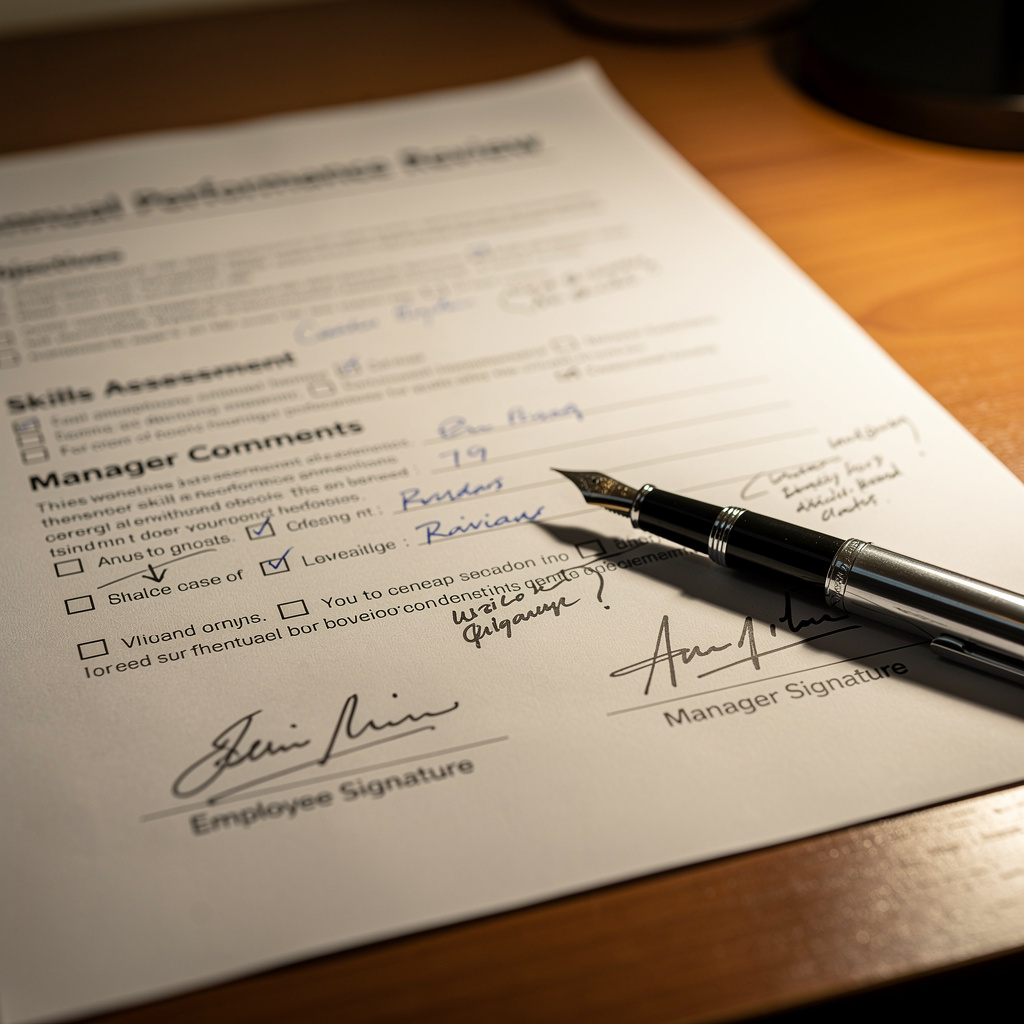
Documenting an annual performance appraisal is no small task: you need to accurately capture what was discussed, set clear objectives, and produce a document that will serve as a reference point for the entire year ahead. Here’s what you need to know:
- A structured template covering the year’s review, competencies, development areas and objectives for the coming year is the foundation of a strong appraisal write-up.
- The tone must be factual and constructive: out with vague judgements, in with concrete examples and measurable commitments.
- Joint sign-off by manager and employee validates both parties and gives the document both legal standing and human weight.
- The annual appraisal is not the same as a statutory career development conversation — the two serve distinct purposes.
- AI tools can dramatically cut writing time without compromising quality.
Table of Contents
- The standard template for an annual appraisal write-up
- Tone and writing style
- Common pitfalls and how to avoid them
- Joint sign-off and the link with statutory career conversations
- Saving time on write-ups with AI
- Conclusion: a living document, not a filing exercise
The standard template for an annual appraisal write-up
An annual appraisal write-up is a formal document that summarises the conversation between a manager and their team member, covering past performance and future direction. To be genuinely useful, it needs to follow a structured, repeatable template.
The essential sections
Here are the headings found in the vast majority of professional appraisal templates:
- Review of the past year — key responsibilities delivered, standout projects, challenges encountered.
- Objectives: achieved / partially achieved / not achieved — a factual assessment of each objective set in the previous appraisal.
- Competency assessment — technical skills, behaviours, ability to collaborate.
- Development areas — identified areas for improvement, training needs.
- Objectives for the coming year — 3 to 5 SMART objectives (Specific, Measurable, Achievable, Relevant, Time-bound).
- Employee’s own comments — a dedicated space for the team member to speak freely.
- Mutual commitments — what the manager commits to providing (resources, training, support).
A sample objectives assessment table
| Objective set | Result achieved | Status | Comment |
|---|---|---|---|
| Increase customer satisfaction score to 90% | 87% achieved | ⚠️ Partial | Understaffing in Q3 |
| Onboard and train 2 new team members | 2 team members trained | ✅ Achieved | On schedule |
| Roll out new CRM system | Deferred to next year | ❌ Not achieved | External strategic decision |
Key takeaway: The “objectives not achieved” section is not a space for blame — it’s a space for analysis. Explaining the context helps distinguish individual underperformance from an organisational obstacle.
For more on running effective one-to-ones and regular check-ins, the article One to One: The Essentials for Employee Development covers the fundamentals of ongoing manager–employee conversations.
Tone and writing style
An annual appraisal write-up is an official document, but it must remain accessible. The style should balance rigour with a constructive, human tone.
What the tone should convey
- Factual: base everything on observable facts, not impressions.
- Constructive: frame areas for improvement as levers for growth, not as criticism.
- Balanced: don’t dwell solely on negatives — recognising achievements is just as important.
- Precise: “performed well” is meaningless; “delivered 3 projects on time with a client revision rate below 5%” is actionable.
Phrases to use vs phrases to avoid
| Avoid | Use instead |
|---|---|
| ”Lacks rigour" | "Errors were flagged in 3 monthly reports" |
| "A real asset to the team" | "Exceeded their Q4 sales target by 105%" |
| "Needs to improve" | "Time management coaching is planned for H1" |
| "Always late" | "4 instances of late arrival to team meetings noted between January and March” |
Key takeaway: A strong appraisal write-up is drafted in the third person or impersonally, and should be unambiguous when read back six months later.
Common pitfalls and how to avoid them
Even with a solid template, certain recurring mistakes can drain the document of its value.
The 5 most common pitfalls
- Vague judgements: terms like “unsatisfactory” or “excellent” without supporting evidence make follow-up impossible.
- Objectives that aren’t SMART: setting “improve communication” without any measurable criteria makes assessment impossible the following year.
- One-sided commitments: the document shouldn’t only list what the employee must do — the manager has obligations too (training, resources, time).
- Writing the document alone, after the fact: producing the write-up without input from the employee distorts the record and breeds mistrust.
- Omitting the employee comments section: failing to give the employee a voice can expose the organisation in the event of a dispute.
Key takeaway: An annual appraisal write-up without concrete, dated commitments is nothing more than a filing exercise. Its value lies in its ability to shape actions over the next 12 months.
Joint sign-off and the link with statutory career conversations
Joint sign-off: why it matters and how to do it
Joint sign-off by both manager and employee serves several purposes:
- It confirms that both parties have read and acknowledged the content.
- It validates the agreed objectives and commitments.
- It provides a degree of legal protection in the event of a future dispute.
Signing does not imply total agreement — the employee can add a written note (digital or paper) if they wish to record a reservation about a specific point.
Annual appraisal vs statutory career conversation: don’t mix them up
These two conversations are complementary but distinct:
| Criterion | Annual performance appraisal | Statutory career development conversation |
|---|---|---|
| Legal requirement | No (unless required by a collective agreement or company policy) | Recommended best practice under UK GDPR & ACAS guidance |
| Main focus | Performance, objectives | Career development, learning & development |
| Content | Year review, competencies, objectives for next year | Career path, professional goals, qualifications |
| Written record provided to employee | Strongly recommended | Best practice |
| Consequences of non-compliance | None (unless contractual) | Potential Employment Tribunal exposure |
Under the UK GDPR and the Data Protection Act 2018, any personal data recorded in an appraisal document — including performance ratings and development notes — must be handled lawfully, transparently and securely. Employees have the right to access their appraisal records upon request, in line with ICO guidance on Subject Access Requests. It is strongly advisable not to merge the annual appraisal and a career development conversation into a single document, even if some organisations hold both conversations on the same day.
Saving time on write-ups with AI
Writing a thorough annual appraisal write-up takes between 30 and 60 minutes per employee — a significant overhead for managers running teams of 10 or more.
Before and after an AI assistant: the practical difference
| Step | Without AI | With AI assistant |
|---|---|---|
| Note-taking during the meeting | Frequent interruptions, partial listening | Discreet recording, full attention |
| Writing the appraisal write-up | 30–60 min per appraisal | First draft ready in minutes |
| Structuring to the template | Manual, varies by manager | Automatic, dedicated appraisal template |
| Identifying action points | Done manually from notes | Action plan generated automatically |
| Sharing and filing | Manual email + copy-paste | PDF/Word export in one click |
Assistants like Geremy allow you to record the appraisal — in person via smartphone or over video call — and automatically generate a structured write-up based on a dedicated annual appraisal template. The document captures the objectives discussed, commitments made and development areas identified, without the manager ever losing the thread of the conversation.
What to check before choosing a tool
- ✅ A dedicated “annual appraisal” template available (or fully customisable)
- ✅ Automatic action plan extraction (who does what, by when)
- ✅ PDF and Word export ready for joint sign-off
- ✅ Data hosted in Europe, compliant with UK GDPR & Data Protection Act 2018
- ✅ Audio deleted after processing
- ✅ Works for both in-person and video appraisals
For more on best practices in meeting documentation, the article Geremy: A Professional Solution Without Bias or Effort and the guide How to Write a Clear and Useful Meeting Write-Up in 2026 offer complementary resources.
Conclusion: a living document, not a filing exercise
An annual appraisal write-up only has value if it is revisited, shared and acted upon. The template, the tone, joint sign-off and the distinction from statutory career conversations are the foundations. But it is the quality of the follow-through — checking in on objectives at the mid-year point, honouring the manager’s commitments — that transforms an administrative document into a genuine development tool.
If you’re looking to cut the time spent on write-ups while improving accuracy, Geremy offers a dedicated annual appraisal template, automatically extracted action plans and an export ready for joint sign-off — fully compliant with UK GDPR and hosted in Europe.
About Geremy: Geremy is an AI assistant that records your meetings and appraisals — in person or over video call — and generates a clear, structured write-up and action plan within minutes, drawing on over 50 ready-to-use templates. Hosted in Europe, compliant with UK GDPR, audio is deleted after processing and never used to train AI models. Find out more
Frequently Asked Questions
What is the standard structure for an annual appraisal write-up?
An annual appraisal write-up typically includes: a review of the past year, an assessment of objectives met or missed, a competency review, development areas, and objectives for the year ahead. It closes with joint sign-off by both manager and employee.
What is the difference between an annual appraisal and a statutory career development conversation?
An annual performance appraisal focuses on performance and objectives; it is not a legal requirement but is widespread practice. A statutory career development conversation, as recommended under ACAS guidance and good HR practice in the UK, focuses on the employee’s longer-term career path, learning and development needs.
Is joint sign-off on the annual appraisal write-up mandatory?
Joint sign-off is not a statutory requirement for annual appraisals, but it is strongly recommended. It confirms that both parties have acknowledged the document and validates the commitments made. For formal career development conversations, providing a written record to the employee is considered best practice.
What are the most common mistakes in an annual appraisal write-up?
The most frequent errors are vague judgements without concrete evidence, the absence of measurable objectives for the coming year, and failing to formalise commitments from both parties. An imprecise write-up quickly loses its value as a management tool.
Which tool can automatically generate an annual appraisal write-up?
AI assistants like Geremy record the appraisal (in person or over video call) and generate a structured write-up within minutes, based on a dedicated annual appraisal template. The document can be exported as a PDF or Word file and is ready for joint sign-off.
How long does it take to write an annual appraisal write-up?
Without a tool, writing up typically takes 30 to 60 minutes per appraisal, on top of review and formatting time. With an AI assistant, the first draft is available within minutes, allowing the manager to focus on the quality of the conversation itself.
Can AI be used for appraisal write-ups while maintaining confidentiality?
Yes, provided you choose a tool that is compliant with UK GDPR and the Data Protection Act 2018, with data hosted within the European Economic Area. Geremy, for example, hosts data in Europe, deletes audio after processing, and never uses recordings to train AI models.